
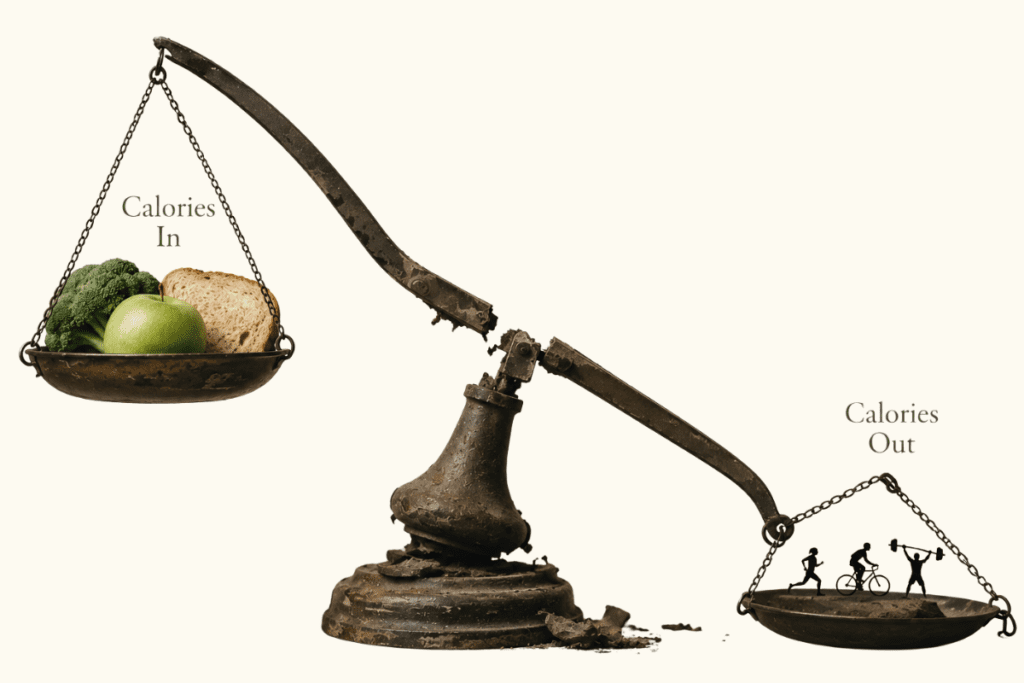
If you’ve ever tried to change your body composition, you’ve probably heard the same old advice: eat less and move more to lose weight, eat more to gain weight. Calories in, Calories out (CICO). It’s on every nutrition label, every fitness app, repeated by many fitness coaches and health care practitioners. It feels like settled science: something so obvious it doesn’t even need explaining. If you intake more energy than you use, you gain weight. If you use more energy than you intake, you lose weight. Simple math.
What if I were to tell you there was more to the story? What if I were to argue that this model is not just an oversimplification, but both an unscientific explanation and not a useful heuristic for changing one’s body composition? Well before I sound outright crazy for challenging this well accepted idea, I first need to paint this argument in its strongest light because if we’re going to challenge an idea this deeply embedded, we owe it the courtesy of properly understanding it first.
The Case for CICO
On the surface this logic seems airtight. Food is comprised of macromolecules: fats, proteins, and carbohydrates. When burned in a bomb-calorimeter, each of these produce a measurable amount of heat energy defined as calories. This reflects the “Calories in” side of the equation. Your body meanwhile requires energy to breath, digest, think and exercise. This is the “calories out” side of the equation. If you consume more energy than your body requires, the excess gets stored as body fat. Consume less, and your body makes up the difference by using some of your fat reserves.
This logic seems to line up with how we evolved. For most of human history, food was scarce. A body that could efficiently store energy during brief periods of excess would be more likely to survive the extended periods of scarcity. The problem, according to this framework, is that we now live in environment where food access is abundant, and sedentary living is the normal. Too many calories in, not enough calories out. If only we we balanced out this equation, we would solve the obesity epidemic and associated ailments.
Key Problems with CICO
1. Humans are not Bomb Calorimeters
The human body does not burn food for fuel, nor does it run on heat energy. Our cells breakdown some of the macronutrients in food to make ATP, which is then used by cells. ATP is the energy currency of the body, not calories, and the amount of ATP generated is heavily dependent on various other inputs. To describe the amount of “calories” that are theoretically contained in a given food as a substitute for the amount of ATP that the body generates as part of a tightly regulated metabolic process is fundamentally misleading.
Furthermore, a certain proportion of the macronutrients never get used to make ATP at all. Protein is primarily used to rebuild body tissues, fats can be used for our cell membranes, and fibre is indigestible by humans and doesn’t contribute to a meaningful amount of ATP besides for a small portion of fibre that is fermented by gut bacteria. Yet all of these are counted as “Calories in”.
Even the macronutrients that do get used to make ATP don’t follow the simple path that CICO implies. Excess fats and carbohydrates beyond what the body can metabolize are not converted into ATP before being stored. Instead they are converted into triglycerides, the body’s fat storage molecule. They are only converted to ATP when the body is ready to use it. So the notion of excessive “Energy in” promoting fat storage is inaccurate, as the molecules that comprise adipose tissue are never energy to begin with. This process is rather the interchange of different forms of mass.
In a nutshell, the human body doesn’t consume or use calories. Using calories as a metric is an incorrect unit that doesn’t convert in any useful way to the correct one.
2. The Calories Out Side of the Equation is not Fixed
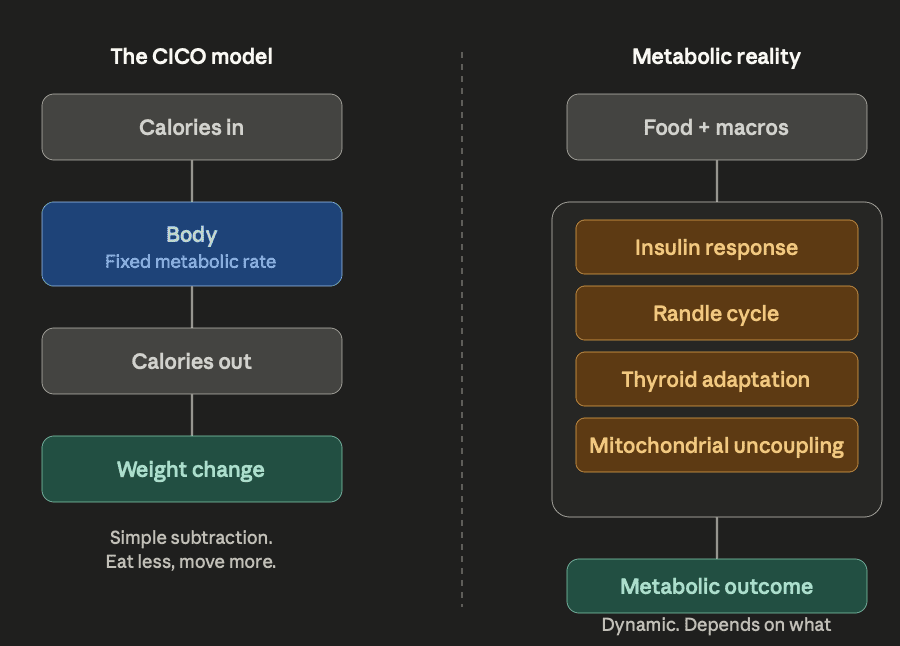
In order to assess this side of the equation, CICO operates under the assumption that each person has a somewhat fixed basal metabolic rate, meaning the rate at which we utilize fuel to function on a regular basis, which in conjunction with that day’s exercise demands would add up to form the total energy expenditure of the day. The problem? Well the foods we eat have significant effects on our body’s metabolism, heavily influencing the so called “Calories out” side of the equation. Here are some examples:
Nutrient density- B vitamins, magnesium, CoQ10 are all required nutrients for proper functioning of the electron transport chain, a key step in generating ATP. More nutrient dense foods lead to more efficient energy production and a higher metabolic rate. This means that two diets with identical calorie counts can produce meaningfully different outcomes without any change in exercise.[1][2]
Deuterium- Foods higher in deuterium slow down the rate at which your mitochondrial motor functions. Therefore foods equal in so-called “calories” with varying levels of deuterium produce energy at different rates and have different results.[3]
The Randle Cycle- Eating a diet rich in both fats and carbohydrates results in substrate competition that cross-inhibits the opposing substrate’s energy pathway slowing overall energy production. The mix of what you eat changes how efficiently you can utilize it for fuel, and how likely you are to store excess.[4]
Mitochondrial Uncoupling- In certain metabolic states, such as ketosis and cold-exposure, mitochondria dissipate energy as heat, rather than produce more ATP. More energy has been consumed without any additional storage, meaning the “calories out” number has just shifted with no way of properly accounting for it.[5]
Thyroid down-regulation- Chronically under-eating can suppress T3 production lowering the body’s basal metabolic rate. The body senses that you have been chronically under-eating and adapts to the deficit as an evolved protective mechanism to the perceived scarcity. This is why suggesting that individuals just simply “eat less and move more” often results in stalling and rebounding.[6]
3. Inaccurate Measurement
The amount of so-called “calories” contained in a given food is allowed to be off by +-20% on the food label. This is a significant source of error and makes effectively counting one’s caloric intake inaccurate and impossible. In summary, we are both dealing with the wrong units and are unable to accurately measure these incorrect units effectively.[7]
4. Food Quality Impacts Satiety
The human body has no sensor for determining the amount of so-called “calories” one has consumed in a given meal. Our body’s rely on very specific hormonal signals to determine hunger and satiety. Over the long-term, people tend not to eat according to what their calorie counting app says, but according to their satiety signals. This challenges the notion that calorie counting is even an effective way to lose weight, let alone a scientifically accurate model. Here are some examples of how different foods affect satiety differently independent of calorie content.
Blood Sugar Volatility- Foods that spike your blood sugar lead to a rapid rise, followed by a subsequent fall in blood sugar. Low blood sugar leads to energy crashes and hunger. You can eat “enough calories” and still be ravenous just a couple hours later.[8]
Leptin Resistance- Foods that drive inflammation impair your brain from properly responding to the fullness hormone leptin. The greater the inflammatory status, the more likely you are to overeat and store fat.[9]
Nutrient Density- The body senses the status of specific micronutrients rather than calories. People often stop feeling hungry when nutrient demands are met, and it is very difficult to overeat foods rich in bioavailable nutrients.[10]
Practical Takeaways
So if calories aren’t the variable that matters most, what actually matters when it comes to my food intake?
The actual chemical composition of your food, the quantity of each specific molecule and what each molecule actually does once they enter your body. The specific molecules in your food dictate your hormonal response, inflammatory response, mitochondrial function and satiety signalling. These processes are what determines whether your body stores fat or uses it for fuel, whether you feel full or hungry, whether you feel consistent energy or frequent crashes. CICO treats food as a fuel with a number attached, but food is a set of chemical instructions. Your body responds to those instructions in ways that a calorie label will never capture. In future posts, I’ll dig into how specific macronutrients, micronutrients, and other chemicals found in food actually affect your metabolism and health.
References
- Depeint F, Bruce WR, Shangari N, Mehta R, O’Brien PJ. Mitochondrial function and toxicity: role of the B vitamin family on mitochondrial energy metabolism. Chem Biol Interact. 2006;163(1–2):94–112. Available from: https://reven.com/wp-content/uploads/2020/06/depeint2006.-Mitochondrial-function-and-toxicity.-role-of-B-vitamin-family.pdf
- Swanton T, Bishop G, Engelbrecht L. Mineral requirements for mitochondrial function: a connection to redox balance and cellular differentiation. Free Radic Biol Med. 2022;182:182–196. Available from: https://www.sciencedirect.com/science/article/pii/S0891584922000752
- Boros LG, Lech JC, Somlyai G, Répás A. Nutritional deuterium depletion and health: a scoping review. Front Nutr. 2024. Available from: https://pmc.ncbi.nlm.nih.gov/articles/PMC11471703/
- Hue L, Taegtmeyer H. The Randle cycle revisited: a new head for an old hat. Am J Physiol Endocrinol Metab.2009;297(3):E578–E591. Available from: https://pmc.ncbi.nlm.nih.gov/articles/PMC2739696/
- Mailloux RJ, Harper ME. Mitochondrial uncoupling: a key controller of biological processes in physiology and diseases. Free Radic Biol Med. 2019;142:122–133. Available from: https://pmc.ncbi.nlm.nih.gov/articles/PMC6721602/
- Fontana L, Klein S, Holloszy JO, Bhatt DL. Caloric restriction but not exercise-induced reductions in fat mass decrease plasma triiodothyronine concentrations: a randomized controlled trial. Rejuvenation Res. 2006;9(1):64–69. Available from: https://pmc.ncbi.nlm.nih.gov/articles/PMC2649744/
- US Food and Drug Administration. Guidance for industry: guide for developing and using databases for nutrition labeling. Available from: https://www.fda.gov/regulatory-information/search-fda-guidance-documents/guidance-industry-guide-developing-and-using-data-bases-nutrition-labeling
- Wyatt P, Berry SE, Finlayson G, et al. Postprandial glycaemic dips predict appetite and energy intake in healthy individuals. Nat Metab. 2021;3(4):523–529. Available from: https://pmc.ncbi.nlm.nih.gov/articles/PMC7610681/
- Zhao S, Zhu Y, Schultz RD, et al. Leptin and leptin resistance in obesity: current evidence, mechanisms and future directions. Front Endocrinol. 2025. Available from: https://pmc.ncbi.nlm.nih.gov/articles/PMC12486228/
- Tremblay A, Bellisle F. Nutrients, satiety, and control of energy intake. Appl Physiol Nutr Metab. 2015;40(10):971–979. Available from: https://pubmed.ncbi.nlm.nih.gov/26394262/