
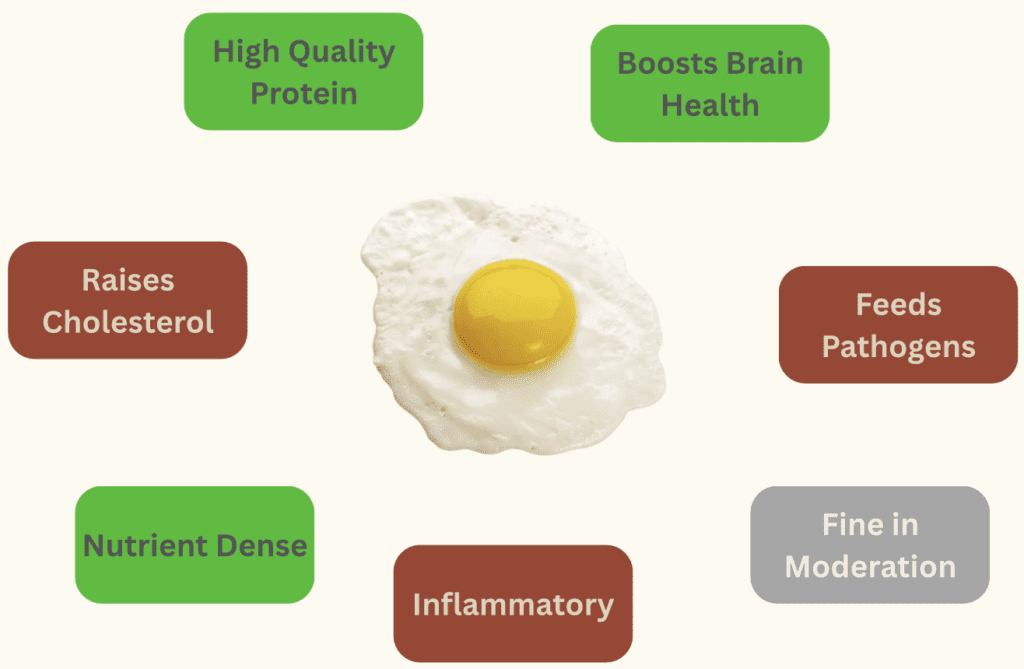
There’s a specific kind of frustration that comes from jumping between studies, podcasts, and credentialed voices online, genuinely trying to find answers that might help you heal, and realizing that they all contradict each other. When I got sick and my practitioners weren’t giving me the answers I was looking for, I did the only sensible thing and began to research. Between my digestive issues, inflammation, and bouts of brain fog, I was confident that my diet was at least part of the story. What I found was a wall of contradictions. According to one source, red meat was driving my inflammation, where others showed no significant relationship. Eggs had been demonized for decades, yet the case against them seemed to fall apart under even the most basic scrutiny. Every source seemed to undermine the last, and the more I dug into the actual research behind the headlines, the more I realized the problem wasn’t just poor communication by journalists, it was far deeper. The science itself was broken. The research wasn’t just hard to interpret, it was fundamentally flawed in ways that were rarely acknowledged. Learning to see those flaws, and knowing where to actually look for reliable answers, gave me the information I needed to heal. It is these tools that I want to equip the reader with in this post.
The Problem With Nutrition Science
The unfortunate reality is that we cannot perform controlled long-term experiments on human beings. Locking human beings in a metabolic ward, feeding them the same things every day, and controlling for every single possible confounding variable would never make it past an ethics board for obvious reasons. Furthermore, every individual has their own unique circumstances which makes certain nutritional inputs affect us differently than it might affect a separate population studied. Therefore, we can never establish cause and effect in human nutrition science. We can only report exactly what was observed, and then use our own reasoning to create inferences of varying strength.
Unfortunately, many credentialed researchers and journalists misreport these limitations. They often use words like “cause”, “risk” and “leads to”. All of these words imply that a cause and effect relationship has been established between two variables, and as I explained above, this is not feasible in the field of human nutrition science.
Consider a 2025 meta-analysis published in Critical Reviews in Food Science and Nutrition, which examined the relationship between red meat consumption and inflammatory markers across 22 randomized controlled trials and 10 observational studies. The headline finding was straightforward: “greater red meat intake led to higher CRP”, a key inflammatory marker, across the trials studied. Sounds damning. But dig a little deeper and the picture falls apart entirely. When researchers looked specifically at unprocessed red meat, the effect on CRP disappeared. In fact, the numbers trended slightly in the opposite direction meaning that unprocessed red meat was associated with lower inflammation. The effect also vanished entirely in participants without pre-existing cardio-metabolic disease. In other words, the signal was being driven by processed meat consumed by people who were already sick. None of this nuance makes it into the headlines. What you get instead is “red meat leads to greater inflammation”, a claim that the data, read honestly, simply does not support.
Why Studies Go Wrong
All nutrition research suffers from a number of the following major flaws:
Confounding variables. Since participants aren’t kept under lock and key, they’re exposed to countless other inputs, dietary and otherwise. This creates systematic bias. Let’s consider the study above, in which processed meat bears a strong association with increased inflammation. Bacon is often eaten in BLTs or with pancakes and hash browns, hot dogs and deli meats are almost always sandwiched between processed refined flour buns and loaded with sugary condiments. The study cannot tell you whether the culprit is the meat, or everything else it’s typically consumed alongside. Moreover, decades of labelling red meat as unhealthy have created healthy user bias, where people who ignore the mainstream advice and eat more red meat are also more likely to engage in other unhealthy lifestyle behaviours. Meanwhile, those who are more health conscious are eating less red-meat. Studies cannot separate meat consumption from the associated lifestyle habits.
Statistical adjustment. To address known confounders, researchers use multivariate regression, adjusting results based on factors like BMI, smoking, or exercise that have supposed known effects. The problem is that our understanding of how these variables interact is itself based on associative data. You end up with models adjusting for confounders using relationships that were never causally established, compounding uncertainty rather than reducing it.
Self-reporting. Most studies rely on participants accurately reporting what they ate, sometimes recalling months or years of dietary choices through questionnaires. If most people can’t remember what they had for lunch yesterday, they are unlikely going to be able to accurately recall the frequency with which they ate foods over a number of months or even years. This creates an extremely noisy dataset.
Short duration, small samples. Studies with tighter controls, like daily food logs or daily blood draws, tend to be expensive, so they run for weeks or months with small groups. Any results can’t be extrapolated to long-term health outcomes, severely limiting their real world application.
Poor generalizability. To capture hard outcomes like disease or death, studies often recruit older populations. But what does a study of 65-year-olds with decades of previous unstudied dietary and lifestyle habits tell us about a 25-year-old? Very little. Extrapolating weak signals to different demographics is bad science.
Lack of repeatability. If a causal relationship exists, repeating the study should yield the same result. It often doesn’t. Many studies never replicate, and many failed replications never get published, leaving us with a skewed picture of what the research actually shows.
Industry funding. Nutrition research is often funded by food companies with vested interests. This wouldn’t matter if studies were rigorous, but given how easily results can be shaped through selective grouping and statistical adjustment, funding sources introduce real bias.
The Hard Sciences: A Stronger Foundation
If most of this observational data is this unreliable, how do we actually make high quality evidence based recommendations?
In my opinion, the answer lies in the “hard science” fields, where experiments are repeatable and findings are based on real observable mechanisms. Paleoanthropology tells us what humans have eaten during the majority of our evolutionary past through stable isotope analysis and fossil records. Evolutionary biology and comparative anatomy show us how the human body is adapted to eat given these ancestral eating patterns as reflected in our digestive tract, stomach acidity, and specific metabolic pathways. Biochemistry reveals how specific compounds interact with human physiology at the cellular level, further pointing us to which foods are optimal for humans.
These fields form the basis for the proper human dietary framework: we know what humans have eaten for hundreds of thousands of years, we know how our bodies have adapted to these inputs, and we understand how modern foods can disrupt optimal physiological function. These principles give us a solid foundation to build recommendations from. Seeing how these principles hold up in practice is the final piece of the puzzle.
Clinical Experience, Healing Anecdotes, and N=1 Science
Good science is not accepting a fixed set of conclusions, it’s a process of asking questions, running experiments, and refining our understanding based on results. Each time we ask a new question or run a new experiment we get slightly closer to the truth.
Healing anecdotes and clinical experience are not scientific proof in the traditional sense. Just like observational studies, they cannot establish cause and effect. However, when thousands of people make a specific change and achieve extremely positive results, we have to ask why. Forming a hypothesis based on these observations and then testing it again is how science is conducted. When we see countless people returning to ancestral eating patterns and seeing dramatic improvements in their health, that’s a signal worth taking seriously. The fact that these healing stories are exactly in line with what the hard sciences predict furthers the theory that our modern diets are a significant contributor to chronic diseases and that returning to ancestral eating patterns can bring the body back to balance.
Even with this set of evidence, there’s one more key step. We all have different genetics, different microbiota, different daily demands, and different health histories. No universal protocol works perfectly for everyone. This is where N=1 science comes in: you make a change, observe your body’s response, and adjust. Over time, you build an understanding of exactly what your body needs to thrive. Your body is always communicating with you through the language of symptoms. Paying careful attention to exactly how your body responds to specific changes provides a level of information far greater than any study could ever provide.
The hard sciences give you the starting framework. The experiences of others who have walked a similar path show you what’s possible and offer insight into specific interventions worth trying. Your own experimentation reveals what actually works for your body. It’s the composite of all these pieces that forms the basis for a properly constructed nutritional protocol. If you’re curious how a health coach can help you navigate this hierarchy of evidence and apply it to your own life, see my first post: Do I Need a Nutritionist/Health Coach?