
Pick up almost any processed food in a modern supermarket and read the ingredients. Somewhere on the list, often near the top, you will find canola oil, soybean oil, sunflower oil, or one of their close relatives. These oils are in chips, crackers, bread, sauces, salad dressings, frozen meals and used as the cooking oil of choice in most restaurants. They comprise a significant proportion of food intake in the western diet. Whether seed oils are actually harmful to human health has become a subject of fierce public debate, and it is something I hope to explore here.
For most of my life, I gave seed oils little thought, regarding them as simply empty calories with no real consideration of other compounds contained within them. When my health took a turn for the worse and I began to dive deep into nutrition research, I noticed that researchers and institutions were deliberately keeping concerns about seed oils quiet. This was not through outright conspiracy, but through quieter mechanisms that shape scientific consensus: researchers burying inconvenient trial, making methodological choices that reliably produce null results, and using surrogate endpoints as a substitute for hard health outcomes. The more I looked, the more I realized that the mainstream did not build their position with solid evidence, but with the accumulated momentum of a narrative that was never properly tested. In this post, I aim to explain what the evidence actually shows about whether seed oils are harmful. This includes historical associations, biochemical mechanisms, and the specific methodological problems with the research that supposedly exonerates them.
Unearned Mainstream Credibility
If you were to ask a mainstream dietitian, cardiologist, or public health body what they thought of seed oils the answer would be remarkably consistent. Seed oils are heart healthy because they lower LDL cholesterol and replace dangerous saturated fats. The American Heart Association recommends their use and a significant amount of published research seems to support the notion that seed oils are not harmful. For an ingredient consumed in negligible quantities throughout most of human history, seed oils have accumulated an extraordinary degree of institutional confidence [1][2]. This position is not completely unfounded. Seed oils do in fact lower LDL levels and there are associative studies that seemingly link them to better cardiovascular disease outcomes. However, once we really unpack this evidence we will see that this position is far weaker than it seems.
An Evolutionary Mismatch
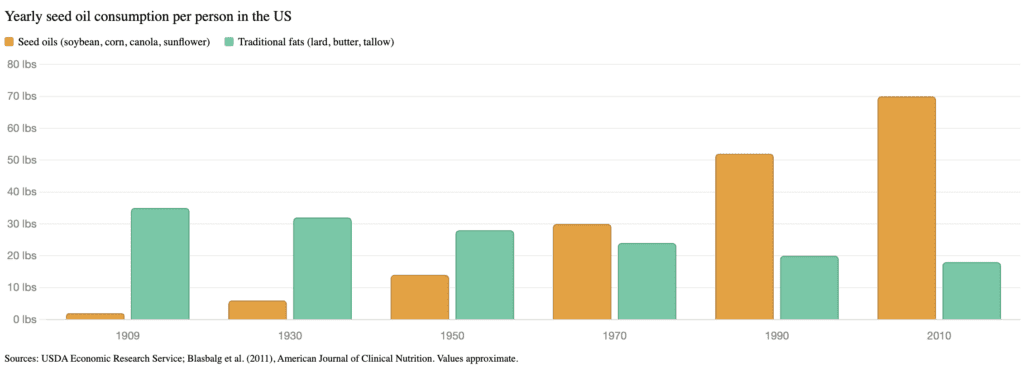
For the vast majority of human and pre-human evolutionary history, the fats in our diets came from animals. Through positive and negative selective pressures, the human body adapted to this diet, and therefore is best equipped to metabolize animal fats. Plant fats existed in the diet in small amounts, but these were primarily from seasonal whole food nuts and seeds. The concentrated extraction of oil from seeds at the industrial scale we see today simply wasn’t possible until the development of modern chemical processing. These oils are a 20th century invention and played no meaningful role in the human diet prior to modern industrial production. They entered the food supply quietly, spread rapidly through processed foods, and became a dietary staple for billions of people without anyone ever testing them for long-term safety.
Its worth noting exactly how the health landscape changed since seed oils were introduced into the food supply. At the beginning of the 20th century, infectious disease were the leading cause of death. By the 21st century they had been replaced by chronic diseases like type 2 diabetes, cardiovascular disease, and cancer[3]. These conditions are astonishingly rare amongst hunter-gatherer and non-westernized populations eating their traditional diets[4]. This is not proof that seed oils alone are responsible. Many factors changed simultaneously and association cannot establish causation. However, seed oils represent a significant dietary shift that coincides with a population-wide shift in disease burden that is otherwise absent in populations not consuming these foods. This in my opinion warrants serious investigation.
The Manufacturing Process
Virtually all seed oils in the modern food supply are industrially extracted, not cold-pressed.
This process involves exposing seeds to high heat, using chemical solvents like hexane, and multiple rounds of refining, bleaching and deodorization to remove the rancid smell that results from this extraction process[5]. The end result is a highly refined, chemically altered substance that bears little resemblance to anything found in nature. The fact that manufacturers have to chemically remove the rancid smell is the first clue that something has gone awry.
Rancidity is more than just an odour, it is the biochemical degradation of the fat molecules themselves. Seed oils contain predominantly Linoleic acid, an omega-6 polyunsaturated fatty acid. The term polyunsaturated refers to the multiple double bonds between carbon atoms in the fatty acid chain. These bonds are chemically unstable, rendering polyunsaturated fats highly susceptible to degradation when exposed heat, light and oxygen[6].
A fresh seed contains protective mechanisms, a fibrous shell, vitamin E, and polyphenol antioxidants that protect the oil inside from rancidity. The industrial extraction process strips away all these protective mechanisms and exposes the delicate fat molecules to the very conditions that are most likely to degrade them. By the time a bottle of seed oil reaches your kitchen, it has already endured high-heat extraction, extended time on a shelf in clear bottle leading to light related degradation, and additional heating when it is then used for cooking again. The result is the generation of significant quantities of toxic aldehyde byproducts[7][8]. Animal and cell-culture models both demonstrate that these compounds damage cell membranes leading to aging and the type of endothelial tissue damage associated with atherosclerotic heart disease. This same research shows that these compounds directly damage DNA, a process heavily implicated in carcinogenesis[8][9].

The dose of toxic aldehyde byproducts found in seed oils is not trivial. Researchers estimate dietary acrolein intake (one of these aldehydes) to be 2.35mg per day from fried foods alone, a figure that far exceeds established safety thresholds[8][9][10]. Given that this only accounts for a fraction of total seed oil exposure, the actual figure is likely even larger. Critically, the cell culture and animal model evidence documenting cellular damage was not conducted at doses far removed from the modern human’s standard western dietary reality. The research shows that these compounds exert pro-inflammatory effects at concentrations consistent with a normal western diet consumption levels [8][9].
It’s also worth noting that Linoleic Acid remains chemically vulnerable to oxidation when it’s incorporated into your tissues like cell membranes, mitochondrial membranes and fat stores. Routine cellular energy production produces reactive oxygen species that continuously peroxidize a small fraction of tissue-bound Linoleic-acid, generating the same family of toxic aldehydes endogenously. This is going to be an order of magnitude less of these compounds than one would consume from food cooked in commercial seed oils, but it helps explain why the mechanistic concerns don’t go away the moment someone stops cooking with seed oils.
Studies Designed to Miss the Signal
We’ve just established that seed oils contain well-characterized toxins with documented mechanisms of cellular damage at quantities that are regularly consumed in the western diet. This raises an important question: why are these oils not only tolerated, but are actively being recommended by some of the world’s most prestigious health institutions? The answer lies in understanding the specific types of research that form the basis of these recommendations and what these types of studies are actually capable of showing. I outline a number of common issues with these studies in my post: Navigating Human Nutrition Science.
Observational Cohort Studies
In these studies, large amounts of older participants track their food intake using food frequency questionnaires, and researchers then correlate their reported intake with hard health outcomes. These questionnaires are entirely self-reported with recall periods typically around a full year. A commonly cited example is a 2014 Harvard meta-analysis which pooled data from 13 prospective cohort studies covering 310,000 individuals and concluded that higher linoleic acid intake (i.e. seed oils) was inversely associated with coronary heart disease incidence [11]. The claim made on the basis of studies like is that seed oils are not driving chronic disease and may even be protective.
Before we get into the deepest methodological flaw, its worth pointing out the extraordinary noise inherent in this type of data: self-reported dietary recall over a long period of time, significant lifestyle confounders that researchers cannot effectively track, and the populations of study consisting of older adults with decades of prior dietary inputs that researchers cannot simply reconstruct.
The larger problem, however, is what happens during analysis. These studies apply multivariate regression to statistically adjust data to “account for” confounding variables like BMI, metabolic syndrome and diabetes. The justification for this is that this isolates the effect of seed oils from other factors. The problem is that these conditions are precisely what seed oil consumption, over decades, is hypothesized to cause. By statistically adjusting them out of the model, the researchers systematically removed the people who would have been most harmed by seed oils from the analysis, leaving in only those who had consumed seed oils without developing overt metabolic dysfunction. The signal disappears not because seed oils are safe, but because the methodology is structurally blind to any damage they might cause.
Randomized Controlled Trials (RCTs)
This is a meretricious term, as these trials are not done under any real control. Rather they are trials with a control arm to use as a comparison against a group with a defined intervention. The typical seed oil RCT takes one group of participants and replaces some other cooking fat (often a saturated fat like butter) with seed oils in their diet. After a short period of time, often weeks to months, the researchers will measure proxy markers and present changes in these markers as evidence of improvement in cardiovascular and metabolic health. The fundamental problem with this is that these markers themselves have no established cause and effect relationship with hard health outcomes, and the changes reflected in this study cannot demonstrate any improvement to health.
The most commonly cited markers are LDL, HOMA-IR, fasting glucose and fasting insulin. LDL is conventionally described as “bad cholesterol” and reduction is presented as providing cardiovascular protection. However, the Minnesota Coronary Experiment directly tested this hypothesis and found seed oils did in fact reduce LDL when substituted for saturated fat, but actually increased mortality rates. In fact, for every 30 mg/dL reduction in cholesterol, there was a 22% increased incidence of death [12]. Markers like HOMA-IR, fasting glucose and fasting insulin are meant to be proxy measures for insulin resistance. However, small changes over short periods of time have not been shown to be pathological and there is no evidence to suggest that a slightly increased HOMA-IR, fasting insulin, or fasting glucose are reflective of increased diabetes incidence or cardiovascular mortality. Furthermore, the established mechanisms by which seed oils likely damage tissue would be a low-grade chronic damage that accumulates over years and decades. This is not likely to be reflected in short term proxy blood markers.
Practical Takeaways
There will never be any study that can prove that seed oils, or any other compound in our food is directly causing chronic disease. However, the hard sciences all point in one direction. Seed oils contain well characterized toxic byproducts at levels that exceed established safety thresholds. At the levels being consumed, these compounds have been shown to be directly damaging to tissue both in vitro and in animal models. Seed oils have only been a large portion of the human diet for less than a century, which is insufficient time for our bodies to make the appropriate evolutionary adaptation to mitigate this damage. The onus should be on researchers to actually prove safety, something they have failed to do given their flawed research methods and something they cannot effectively do given the nature of research and ethics. Therefore, the only evidenced based position is to severely limit or completely avoid consuming them.
The good news is that avoiding seed oils doesn’t require an extreme or restrictive approach to eating. Meaningful reduction to exposure is easily achievable with the following changes:
Cooking at home
Here the switch is simple: replace seed oils in your kitchen with ancestrally consistent fats that are minimally processed and low in unstable polyunsaturated fats. The best sources are animal fats: tallow, butter, ghee, and pasture-raised lard. Virgin coconut oil can also be used for high-heat cooking due to its low polyunsaturated fatty acid content, whereas extra-virgin olive and avocado oils are best suited towards lower-heat applications. These avoid any significant amounts of the toxic aldehyde products that make seed oils problematic.
Processed and packaged foods
Most processed and packaged foods will contain seed oils. You will find one type of seed oil or another in most crackers, sauces, dressings, protein bars, and frozen meals. This is not universal however, and reading ingredient labels can become a useful habit. Each day there are more and more products being created that are completely free of seed oils. However, the best practice is simply to prioritize whole foods as the base of your diet, limiting consumption of processed and packaged foods as best you can given your life circumstances.
Eating at restaurants
Seed oils are the default cooking fat in virtually every restaurant and fast food outlet, where they are often reused repeatedly, compounding the oxidative damage they cause. This is the hardest exposure to control, but it is worth taking seriously as these can present some of the highest single-meal toxic aldehyde exposures. The practical implication is not that restaurant meals need to be eliminated entirely, but that frequency matters. Deep fried items deserve particular caution, since commercial fryer oil is typically held at high temperatures for hours or days and reused across many batches, generating a far more concentrated dose of toxic aldehydes than fresh oil would. Make cooking at home with indicated heat-stable fats as your default, eat out only on occasion, and when eating out don’t consume foods cooked in commercial fryers.
It’s also worth noting that due to increased awareness there are some restaurants that have begun switching over to more appropriate cooking fats. The app “seed oil scout” can be a useful tool for identifying restaurants that offer alternatives. Many restaurants have alternative choices on hand, which they can substitute on certain menu items if you ask. I know this is annoying and many people can tolerate brief exposures in an otherwise healthy diet. However, I think that the more times a restaurant hears that someone doesn’t want to consume seed oils, the more likely they are to make a genuine change and I’d appreciate everyone’s help to make this world a little less toxic.
The broader point is that seed oils are deeply embedded in the modern food supply and eliminating them entirely requires very intentional eating behaviours. What is both realistic and meaningful is making them the exception rather than the rule. Prioritize stable fats at home, choose whole foods over packaged foods, and be honest with yourself about how frequently you are relying on restaurants and takeout. When eating out, be mindful of the types of foods you choose. The cumulative daily exposure is what matters, and getting your home environment right, while reducing how often you eat food prepared outside of it will make the biggest difference.
References
Section 1 – The Most Defended Food in Modern Nutrition
Section 2 – A 100-Year-Old Experiment
Section 3 – The Manufacturing Process and Its Consequences
Section 4 – How to Make Harmful Foods Look Safe