
Humans are built to crave sweetness. We evolved in a world where food was scarce, and sugar was incredibly rare. Something sweet, like seasonal ripe fruit and honey, was a reliable signal that quick energy was available, which meant fuel for the next hunt or more foraging. Given that sweetness was hard to come by, a brain that rewarded finding it had a survival advantage.
For our ancestors, that pull was kept in check by the effort involved. A sweet reward meant hours of foraging, and honey often came at the cost of many bee stings. Even the fruit they found was a far cry from today’s: smaller, more fibrous and much less sweet than modern cultivated varieties. Today that natural check is gone. Refined carbohydrates and sugar line nearly every grocery aisle and sit in almost every snack, so the reward arrives fast, takes no effort, and is reinforced every time a cue appears. For some people the habit becomes compulsive, and the more refined and concentrated the sugar, the stronger that pull tends to be.
This is an environment our biology never prepared for, with cheap, concentrated sweetness at every turn. That doesn’t mean every sweetener is equally bad, or that the answer is always to avoid them all. It means being deliberate about what you reach for and acknowledging when something has become habit forming in a way that is counter-productive towards your health goals.
Nutritive vs Non-Nutritive Sweeteners
Nutritive sweeteners provide usable energy and are mostly digested and absorbed as sugars. Non-nutritive sweeteners provide little to no energy. The line is slightly blurry: allulose is chemically a sugar but is largely not metabolized, sugar alcohols are only partly absorbed, and yacon syrup is largely indigestible fibre. Because they answer different questions, I’ve split them into separate two tier lists.
The conversation around sweeteners is almost always oversimplified. Some people say all non-nutritive sweeteners are problematic and that real sugar is preferable. Others say that we should prioritize only natural sources of sweetness. Others say that all nutritive sweeteners are the same as refined sugar. I made this post to address the lack of nuance commonly found in this conversation and to hopefully give readers a better understanding of how different sweeteners actually effect their health.
The choice between non-nutritive and nutritive sweeteners relies heavily on your unique life circumstances, physiology, and personal response to different compounds. Generally, I think about the following two client archetypes when deciding which sweetener subset might work better:
If you have blood sugar issues, metabolic syndrome, or carry excess body fat, non-nutritive options are likely the better choice. Even whole-food nutritive sweeteners can spike your blood sugar, which can drive glycation and tissue damage, as well as feed inflammation, hunger and weight gain.
If you’re active, spend time outdoors and are mindful of overall carbohydrate intake, you may do well with nutrient-dense sweeteners like whole fruits, maple syrup or raw honey.
Three Caveats Before You Dive In
- This is not a recommendation to eat large amounts of any sweetener or sugar rich foods. It’s a guide for choosing better options when you want an occasional sweet treat. They should never form the basis of your diet.
- Listen to your body. Humans did not evolve eating large amounts of sugar or any of these other sweet molecules. These other sweet molecules specifically represent novel inputs that our bodies are typically not well adapted to withstand, and any of them can cause odd side effects. This guide summarizes the general science, but how your body responds always comes first.
- Uncertainty is part of the picture. Where the evidence is thin or contested, I’ll say so rather than overstate it, and when in doubt, I’d lean toward the better-studied, lower-risk option.
Nutritive Sweeteners
Since these sweeteners all provide sugar, the question is what comes along with it and how fast it hits. Three factors drive the rankings.
- Nutrient density: Here we are evaluating whether the sweetener brings vitamins, minerals, antioxidants, prebiotics or any other beneficial compound that refined sugar lacks.This varies widely between sweeteners and is one of the main things separating the tiers. Because these nutrients come bundled with sugar, they work best as a reason to choose one sweetener over another, not a reason to use more of it.
- Blood sugar impact: Here we are evaluating how quickly its glucose reaches the bloodstream and spikes blood sugar and insulin. Blood sugar swings can drive hunger and cravings, while spikes themselves can be very damaging to the body’s tissues and accelerate aging. It’s worth noting explicitly that blood sugar impact can vary wildly from person to person, and while the glycemic index acts as an estimated value of blood sugar impact, it can be a poor proxy for your unique blood sugar response.
- Fructose load and speed of absorption. Fructose barely moves blood sugar, which is why glycemic index can make a sweetener look better than it is, but fructose carries its own concerns independent of blood sugar. In small amounts, the gut handles most of it, but a large, fast dose overwhelms that capacity and excess goes to the liver. There fructose is converted into fat and raises uric acid, both of which have been linked to fatty liver and insulin resistance. This is why fructose load, and speed of absorption matter most here. Fructose arriving slowly with fibre and other food can be far more manageable than a concentrated syrup or sweetened drink.
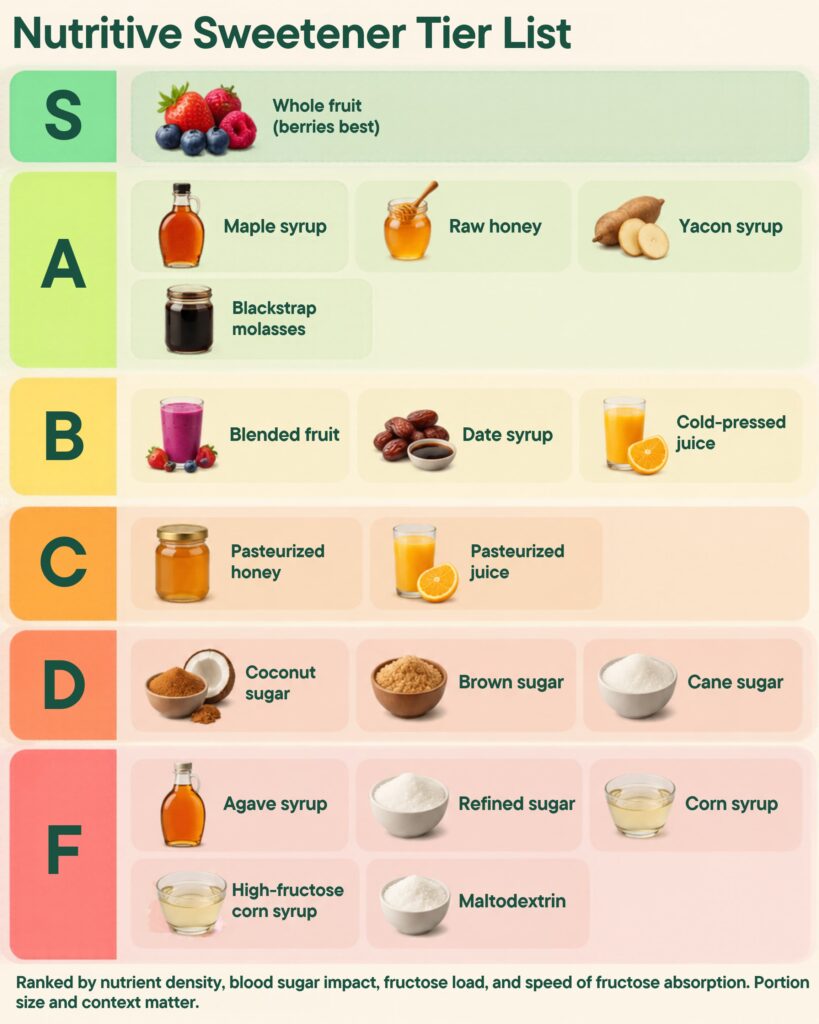
Whole Fruit (S). Whole fruit is the standard the other sweeteners are measured against. The fructose and glucose arrive inside intact cell walls with fibre and water, so they’re absorbed slowly and stay within what the gut can handle[1]. Whole fruits also provide vitamins, potassium and polyphenols. Not all fruit is equal, though. Berries sit at the top: they’re lower in sugar, higher in fibre, and richer in antioxidants than most other fruits. Fruits like apples, citrus and pears follow close behind, while higher-sugar options like grapes, mango and ripe bananas deliver more sugar per serving. Dried fruit sits at the bottom of this tier, since removing the water concentrates the sugar and makes it easy to eat a lot quickly.
Maple syrup (A). Maple syrup is mostly sucrose, so it delivers glucose and fructose together rather than free fructose, with a moderate placement on the glycemic index. Its standout feature is nutrient density: a tablespoon supplies a meaningful share of daily manganese along with some zinc, calcium and potassium. It’s also less concentrated in sugar and fructose per tablespoon than honey. It’s still liquid sugar, so portion size matters.
Raw honey (A). Honey is roughly 38% fructose and 31% glucose, all free and ready to absorb. It has a moderate glycemic index, but that’s largely because fructose barely registers on blood sugar, so the fructose load is the real consideration. However, raw honey retains significant polyphenols and trace compounds that refined sugar lacks, potentially offsetting some of the damage from fructose. It also has significant antimicrobial properties and can coat irritated mucus membranes, both of which can make it helpful for managing symptoms when sick[2]. Given the concentrated fructose levels, its best consumed in moderation and with intention.
Yacon syrup (A). Much of yacon’s sweetness comes from fructooligosaccharides, which humans can’t digest, so they act as prebiotic fibre instead of sugar. That gives it a lower glycemic index value and a lower digestible sugar load than most syrups[3]. The trade-offs are that it still contains free sugars (including fructose), and the prebiotics can cause gas and bloating, particularly in those with gut issues or FODMAP sensitivities. However, in the right context and in the appropriate dose this can feed beneficial bacteria and support a healthy microbiome.
Blackstrap molasses (A). Blackstrap is what remains after the sugar has been crystallized out, so it’s less sweet and more nutrient-dense than any other syrup: a tablespoon provides roughly significant amounts of iron (albeit in a less bioavailable form) and meaningful calcium, magnesium and potassium. The sugar that remains is still mostly sucrose, so it still raises blood sugar.
Blended fruit (B). Blending keeps the fibre, vitamins and polyphenols of whole fruit but breaks down the cell walls that hold the sugars in, making the sugars absorb like free sugars in fruit juice. Imaging studies show purée leaves the stomach about as fast as juice, and whole fruit is noticeably more filling than either [4]. The blood sugar data are mixed: small trials in healthy adults haven’t shown a bigger glucose spike than whole fruit, but insulin and fructose are less studied, and mechanistically one would expect more problems to arise in someone with blood sugar regulation issues[5]. The practical advice is to treat a smoothie as a sweet drink made from good ingredients: keep portions modest, use whole fruit, and combine with protein, fat, and fibre to slow absorption.
Date syrup (B). Date syrup has a roughly even glucose-to-fructose ratio, which is a more balanced fructose load than honey, along with potassium and polyphenols [6]. Reported glycemic indexes vary, and its fibre doesn’t carry over well into syrup form. It’s also high in FODMAPs, which can bother people with IBS.
Cold-pressed juice (B). Cold pressing preserves more vitamins and polyphenols than heat does, but the fibre is gone, so the sugar and fructose arrive fast and in a larger dose than most people would eat as fruit. A small serving with food is reasonable; a large glass on an empty stomach is not. Context matters, and juice can work better for someone post exercise when their glycogen stores can take up excess glucose.
Pasteurized honey (C). The sugar profile is the same as raw honey and the micronutrients are slightly reduced. The heating and filtering process removes many of the polyphenols and other minor compounds, making it less ideal than raw honey[7].
Pasteurized juice (C). The same fast-absorbing, fibre-free sugar as cold-pressed juice, with fewer of the heat-sensitive vitamins and polyphenols that made the cold-pressed version worth ranking higher.
Coconut sugar, brown sugar and cane sugar (D). All three are mostly sucrose, delivering equal parts glucose and fructose with nothing to slow them down. Coconut sugar has a small amount of inulin and some trace minerals, and its glycemic index measurements vary widely between studies, but there’s no good evidence it’s meaningfully healthier. Brown sugar is refined sugar with molasses added back, and cane sugar is essentially sucrose.
Refined sugar, Agave syrup, corn syrup and high-fructose corn syrup (F). These deliver fast glucose and a large fructose load with no nutrients, and they’re most often consumed as liquids, which is the worst case for speed. HFCS has more free fructose than sucrose does, but the evidence that it’s worse in practice is mixed, so treat them as similarly problematic. Regular corn syrup is mostly glucose and hits blood sugar even faster. Agave is mostly fructose with a fast digesting, concentrated dose that your gut has trouble to manage on its own[1], [8][9][10].
Maltodextrin (F). Maltodextrin contains no fructose, but it breaks down almost instantly to glucose, with a glycemic index higher than table sugar and no nutrients to offset it. It’s barely sweet, so it hides in products that don’t seem sugary. Be sure to check ingredient lists in processed foods.
Non-Nutritive Sweeteners
Since these sweeteners provide little to no metabolized sugar, the main question is how much evidence there is that these specific compounds cause harm. I base these rankings on the strength and consistency of the available evidence, whether it comes from human studies or mostly from animals and lab work, and whether there’s a plausible mechanism behind the concern. Sweeteners with a long, clean track record and no credible signals sit at the top, and those with unresolved concerns, such as cardiovascular or metabolic signals, sit lower. A high rank means the best available option, not proof of safety or a green light to use freely.
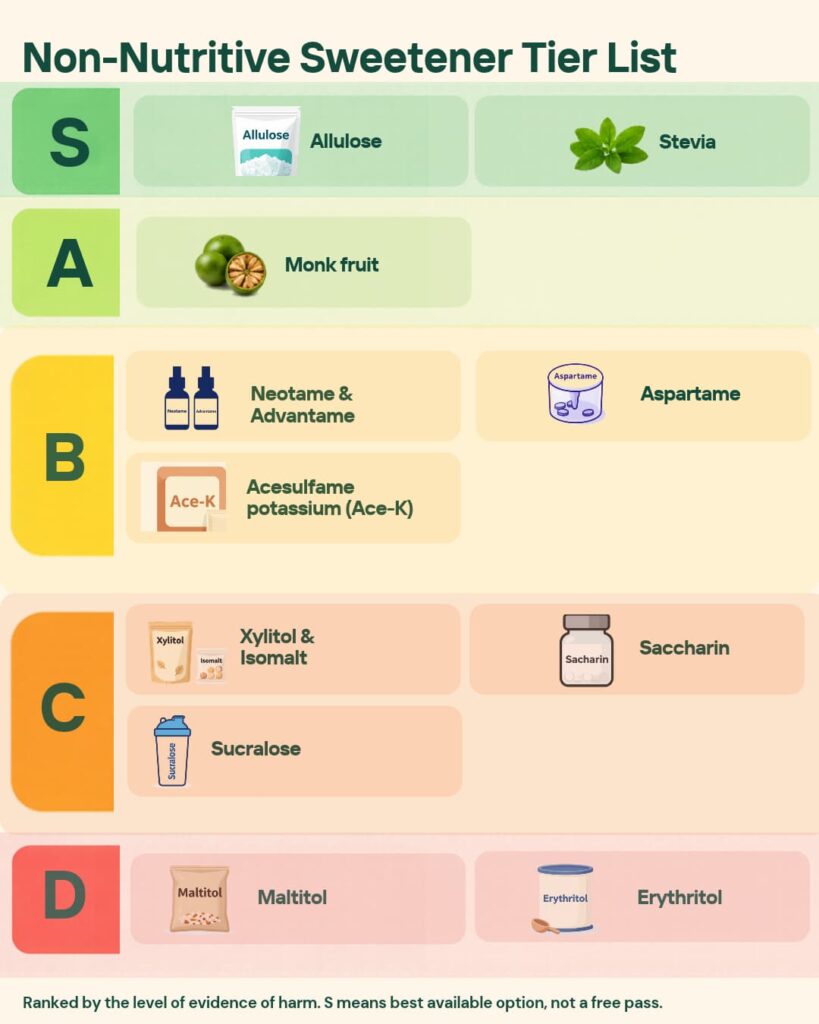
Allulose (S). Allulose is a structural cousin of fructose that the body absorbs but largely cannot use. Most of it is absorbed in the small intestine and excreted in urine unchanged, which is why it doesn’t raise blood sugar. The proposed upside is that it stimulates GLP-1 release and may enhance glucose uptake in the liver[11][12]. The downsides are practical: it’s less sweet than sugar, so you need more of it, and large doses can cause gas and loose stools in sensitive individuals.
Stevia (S). Steviol glycosides activate the same sweet receptors as sugar, plus some bitter receptors, which is why many people notice a bitter or licorice-like aftertaste. They aren’t absorbed in the upper gut. Colonic bacteria cleave off the sugar units to release steviol, which is absorbed, conjugated by the liver and excreted in urine[13], [14]. That bacterial step is the main reason people raise microbiome questions, though human data so far don’t show much disruption. Check the label, since many stevia products are bulked with erythritol (see below).
Monk fruit (A). Monk fruit sweetness comes from mogrosides, large plant glycosides that, like steviol glycosides, mostly pass through unabsorbed until gut bacteria break them down to a smaller molecule, mogrol, which is absorbed[15]. Mechanistically it looks very similar to stevia, with a cleaner taste. The reason it sits slightly lower is that the human and long-term data are thinner, and, as with stevia, retail products are often blended with erythritol or dextrose.
Neotame and advantame (B). Both are modified aspartame molecules. A bulky chemical group attached to the nitrogen blocks the enzymes that would normally release phenylalanine, so PKU is not a concern. Esterases still remove the methyl group, releasing methanol, but their enormous sweetness means only trace amounts are used. The mechanism is reassuring, and the main reason to keep them mid-tier is that little independent research exists beyond regulatory safety testing.[16][17]
Aspartame (B). Aspartame is a small dipeptide ester that’s broken down in the gut into phenylalanine, aspartic acid and methanol, so no intact aspartame reaches the blood. The phenylalanine matters for people with PKU, who cannot clear it. The methanol is a modest amount, comparable to or below what you’d get from fruit juice, and the body handles it through the same liver pathway it uses for the methanol it makes itself. Mechanistic arguments for cancer risk remain speculative, which is partly why regulators judged the evidence limited. The practical argument for ranking it below stevia is simply that cleaner options exist.[18]
Acesulfame potassium (B). Ace-K isn’t metabolized at all: it’s absorbed and excreted in urine unchanged, so it has no impact on blood sugar and has no metabolic breakdown products of concern[19]. It activates sweet receptors and, at higher concentrations, bitter ones, which is why it’s usually blended with other sweeteners to mask the aftertaste. Its slightly lower rank reflects limited independent human research and some epidemiological signals that haven’t been resolved, not a known mechanism of harm.
Sugar alcohols: xylitol, isomalt and similar (C). Polyols are only partly absorbed. The unabsorbed portion draws water into the intestine (an osmotic laxative effect) and is fermented by colonic bacteria, producing gas and short-chain fatty acids. That fermentation is why they can act as mild prebiotics and why dose tolerance is the limiting factor. Xylitol also isn’t fermented by the bacteria that cause cavities, which explains its dental use. They rank low because of their potential for GI upset, and they may be a fine choice if you tolerate them well.[20]
Saccharin (C). Saccharin is not metabolized and is excreted in urine unchanged. The old bladder cancer finding in rats is attributed to a rat-specific mechanism: at very high doses of the sodium salt, the urine becomes alkaline and forms crystals that irritate the bladder lining and drive cell proliferation. That doesn’t occur in humans at normal intakes, which is why the warning label was dropped[21]. It stays mid-tier because it may shift gut bacteria and offers no advantage over better options.
Sucralose (C). Sucralose is sucrose with three hydroxyl groups swapped for chlorine, which makes it unrecognizable to digestive enzymes. Most passes through unabsorbed, and the small absorbed fraction is largely excreted. The concern isn’t about immediate blood sugar impact but signaling: sweet receptors in the gut can trigger hormone release, and the “uncoupling” hypothesis is that sweetness without matching energy weakens the body’s ability to predict and respond to incoming carbohydrate. In a Yale study, consuming sucralose with, but not without, a carbohydrate impaired insulin sensitivity[22]. The evidence is mixed, but it’s a reason to avoid pairing sucralose with carbs and to prefer other options.
Maltitol (D). Unlike most polyols, a meaningful fraction of maltitol is split in the gut into glucose and sorbitol, so it does raise blood sugar, which defeats the purpose for many people using it [23]. It’s also the most fermentable of the group, so it’s the usual culprit behind digestive complaints.
Erythritol (D). Erythritol is different from the other polyols: roughly 90% is absorbed in the small intestine and excreted in urine largely unchanged, which is why it causes less gas, but also why blood levels rise so high[20]. The proposed concern is that it makes platelets more responsive, promoting clotting. One study found people in the top quarter for blood erythritol had about twice the cardiovascular event risk, and a follow-up found a drink with 30 g of erythritol increased platelet reactivity[24]. The caveat is that the body also makes its own erythritol from glucose, so high levels might partly reflect underlying metabolic problems rather than cause them[25]. Its low rank reflects unresolved cardiovascular uncertainty, particularly for people already at risk.
References
- Jang C, Hui S, Lu W, et al. The small intestine converts dietary fructose into glucose and organic acids. Cell Metab. 2018;27(2):351–361. Link
- Yupanqui Mieles J, Vyas C, Aslan E, Humphreys G, Diver C, Bartolo P. Honey: an advanced antimicrobial and wound healing biomaterial for tissue engineering applications. Pharmaceutics. 2022;14(8):1663. Link
- Yan MR, Welch R, Rush EC, Xiang X, Wang X. A sustainable wholesome foodstuff: health effects and potential dietotherapy applications of yacon. 2019. Link
- Krishnasamy S, Lomer MCE, Marciani L, et al. Processing apples to purée or juice speeds gastric emptying and reduces postprandial intestinal volumes and satiety in healthy adults. J Nutr. 2020;150(11):2890–2899. Link
- Crummett LT, Grosso RJ. Postprandial glycemic response to whole fruit versus blended fruit in healthy, young adults. Nutrients. 2022;14(21):4565. Link
- Julai K, Sridonpai P, Ngampeerapong C, et al. Effects of extraction and evaporation methods on physico-chemical, functional, and nutritional properties of syrups from Barhi dates (Phoenix dactylifera L.). Foods. 2023;12(6):1268. Link
- Zarei M, Fazlara A, Tulabifard N. Effect of thermal treatment on physicochemical and antioxidant properties of honey. Heliyon. 2019;5(6):e01894. Link
- Saraiva A, Carrascosa C, Ramos F, Raheem D, Raposo A. Agave syrup: chemical analysis and nutritional profile, applications in the food industry and health impacts. Int J Environ Res Public Health. 2022;19(12):7022. Link
- Review of the effects of fructose compared with glucose on plasma lipoproteins and glucose homeostasis. Link
- Effects of high fructose corn syrup and sucrose on the pharmacokinetics of fructose and acute metabolic and hemodynamic responses in healthy subjects. Link
- Ahmed A, Khan TA, Ramdath DD, Kendall CWC, Sievenpiper JL. Rare sugars and their health effects in humans: a systematic review and narrative synthesis of the evidence from human trials. Nutr Rev. 2022;80(2):255–270. Link
- GLP-1 release and vagal afferent activation mediate the beneficial metabolic and chronotherapeutic effects of D-allulose. Nat Commun. 2018;9(1):113. Link
- Gardana C, Simonetti P, Canzi E, Zanchi R, Pietta P. Metabolism of stevioside and rebaudioside A from Stevia rebaudiana extracts by human microflora. J Agric Food Chem. 2003;51(22):6618–6622. Link
- Absorption and metabolism of glycosidic sweeteners of stevia mixture and their aglycone, steviol, in rats and humans. 2003. Link
- Comparative in vitro metabolism of purified mogrosides derived from monk fruit extracts. Regul Toxicol Pharmacol. 2021. Link
- JECFA. Neotame. WHO Food Additives Series 52. Link
- EFSA. Re-evaluation of neotame (E 961) as a food additive. EFSA J. Link
- UK Committee on Toxicity. Methanol: background paper. Link
- JECFA. Acesulfame potassium. WHO Food Additives Series 28. Link
- Lenhart A, Chey WD. A systematic review of the effects of polyols on gastrointestinal health and irritable bowel syndrome. Adv Nutr. 2017;8(4):587–596. Link
- IARC. Saccharin and its salts. IARC Monographs, Volume 73. 1999. Link
- Dalenberg JR, et al. Short-term consumption of sucralose with, but not without, carbohydrate impairs neural and metabolic sensitivity to sugar in humans. Cell Metab. 2020. Link
- Digestion and absorption of sorbitol, maltitol and isomalt from the small bowel: a study in ileostomy subjects. Link
- Witkowski M, Nemet I, Alamri H, et al. The artificial sweetener erythritol and cardiovascular event risk. Nat Med. 2023;29(3):710–718. Link
- Hootman KC, Trezzi JP, Kraemer L, et al. Erythritol is a pentose-phosphate pathway metabolite and associated with adiposity gain in young adults. Proc Natl Acad Sci USA. 2017;114(21):E4233–E4240. Link